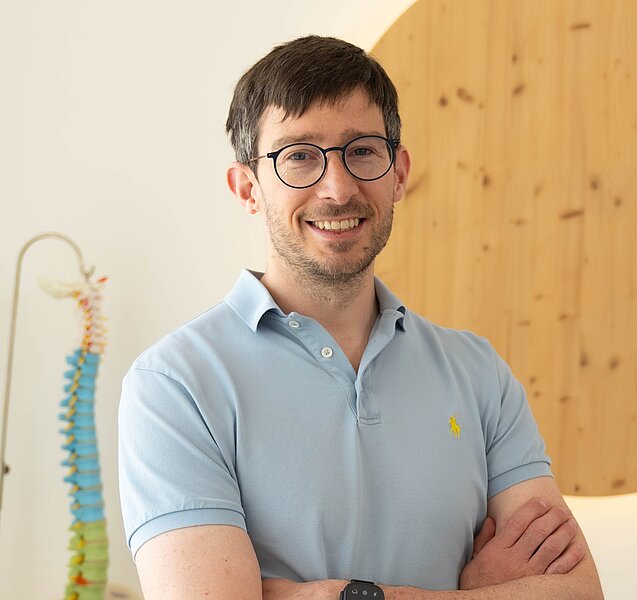
Behind this ruling in court is a professional journey shaped by academic expertise and practical experience. Alexander Maaßen completed his Bachelor’s and Master’s degrees in Chiropractic at DIU between 2011 and 2016. Today, he runs the KörperImpuls practice in Pullach, where he works in chiropractic, physiotherapy, sports physiotherapy, and systemic coaching.
Interview of DIU Alumnus Alexander Maaßen :
1. You fought for this legal clarification for almost nine years. What motivated you to pursue the case all the way to the Federal Administrative Court?
At first, it was probably a certain degree of youthful naivety. I simply wanted to be a chiropractor, not a Heilpraktiker. Later, it was mainly my persistence and determination to finish what I had started. After I won in the first instance, the appeal proceedings unfortunately dragged on for a very long time and were genuinely exhausting at times. I was particularly concerned about whether the final appeal would even be admitted. In the end, I simply wanted a final ruling from the Federal Administrative Court, regardless of the outcome. That makes me even happier with the result, both for myself and for chiropractic in Germany.
2. From your perspective, what does the ruling mean for chiropractors in Germany and for future DIU graduates?
Once the court publishes its written opinion, I hope there will finally be greater certainty for everyone involved, both patients and chiropractors. I expect the WHO guidelines for chiropractic education and training to play a role as well. Public health authorities could use these guidelines as a reference when deciding whether to grant a Heilpraktiker license limited to chiropractic.
I also see a major opportunity for DIU. If the university could collaborate with the relevant public health authority so that graduates receive a Heilpraktiker license limited to chiropractic upon successfully completing the degree program, it would be a genuine game changer. It would make entering the profession much easier and, above all, provide greater legal certainty. That would be particularly valuable for people who feel the same way I do: chiropractic, yes, but not necessarily via the detour of a general Heilpraktiker license.
3. Looking back on your studies at DIU, how did your academic training prepare you for this career path and the challenges of recent years?
First and foremost, the degree program gave me the professional foundation for my daily work. It also gave me confidence that chiropractic is a distinct and clearly defined field of practice. This allowed me to present my qualifications and professional path convincingly to public authorities and the courts. Without that foundation and my confidence in the quality of my education, I probably would not have pursued this lengthy legal process with the same determination.
Learn More About the Chiropractic (B.Sc.) and Chiropractic (M.Sc.) Degree Programs.